
Significant numbers of people with same-sex attraction (SSA) want to change their sexual orientation for personal reasons (personal communication over more than 20 years). Changes in sexual orientation are also borne out by survey material showing widespread and clear changes of orientation towards heterosexuality in sampled populations. (See My Genes Made Me Do It, Ch 12.) But people with unwanted SSA were left with declining professional support after the American Psychiatric Association removed homosexuality as a disorder from its Diagnostic and Statistical Manual in 1973. Increasingly they began to look for support from growing numbers of small groups led by people who had left the gay lifestyle.
Fast forward to 2025 and western governments have begun prohibiting assisted change of sexual orientation by passing legislation that criminalises and heavily fines counsellors, support groups and any practitioner offering services "with the intention of changing or suppressing the individual's sexual orientation..." (This is the wording of New Zealand's Conversion Practices Prohibition Legislation.) Consent is no defence. It was promulgated by the activist stream (and sympathisers) who counted on people's ignorance of the facts and the liberal climate in NZ.
(Ironically, the same bill fully facilitates any practitioner helping people transition from one sex to another, ie., the 'trans' community.) In New Zealand, penalties for infraction are up to 3 years in prison.
The premise on which the legislation is based is the unchallenged belief that change will only cause harm and even severe harm. This premise is a nonsense - as shown in the following Figure (Santero 2017). The view that change causes harm emanated from the American Psychological Association under pressure from gay activist lobbies and was perpetuated worldwide. If it caused harm how is it that there have been huge swings away from homosexuality to heterosexuality over the course of a lifetime in thousands of people. (These are extensively documented in Chapter 12 of My Genes Made Me Do It. )
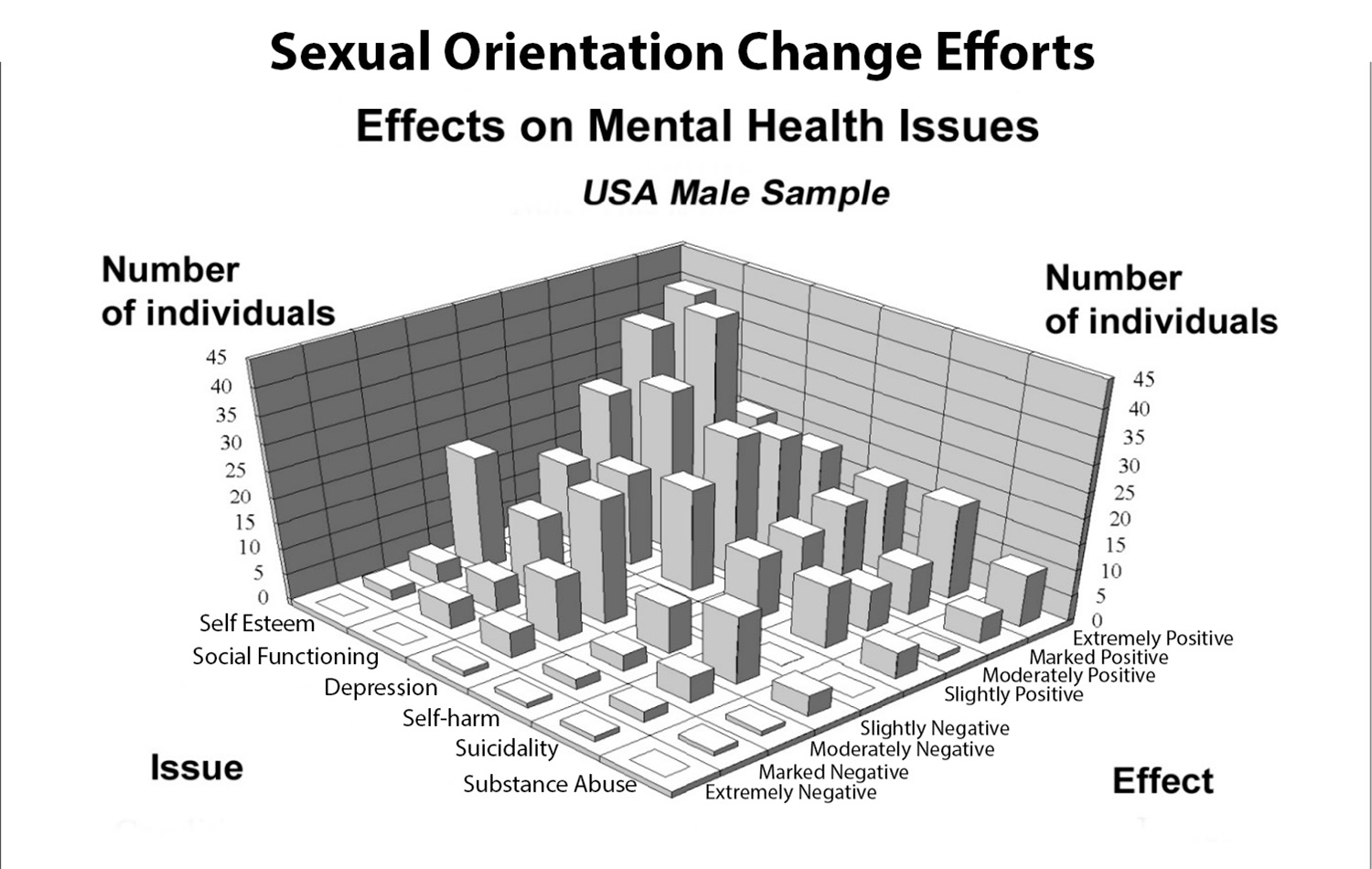
This Figure shows a USA cohort of 125 men followed for three years and their assessment of harm and benefit over that period. People in the mental health professions will be familiar with the "rule of thirds" in which people undergoing any therapy will fall roughly into 3 groups: Those who greatly benefit, those who benefit moderately and those who are not helped. This Figure shows a better result than that. Almost all the men were in professional therapy – all to informed consent standards - and half were in support groups. The men were asked for both positive and negative responses. 70% reported only beneficial results (Data from Sullins and Rosik, submitted 2021 Linacre Quarterly). Most experienced better self-esteem, social functioning, less depression, self-harm, suicidality and substance abuse. Jones & Yarhouse 2007 found very similar results after following 98 gays and lesbians over seven years who attended support groups offering help to change sexual orientation.
The difficulty in redressing the 'harm' to the mental health professions caused by abdication of care for this population is considerable. Since the establishment of policies that assisted change was harmful, practitioners have not received training. Support groups led by former gays filled the gap, but they are in the process of being shut down in some Western countries.
The argument could easily be made that more harm is done to the GLB cohort by legislating to make assisted change illegal than by permitting it.
There is much evidence that the GLB group carries a heavier burden of dysfunction than heterosexuals. The survey literature (Herrell, 1999, Sandfort, 2001, Fergusson, 2005) put it at about three times the level of a control group of heterosexuals. This does not seem to be connected to levels of discrimination, because it remains constant regardless of country, e.g., in New Zealand, a recent survey showed the country had some of the most accepting views towards GLB in the world (Dickson, 2003).
Detailed study of the surveys suggests that the conditions needing counselling are likely to be substance abuse, depression, and problems over relationship breakups. The GLB community lives intensely and breaks up intensely. It has about three times as many partners as a control group of heterosexuals (Laumann, 1993), about three times as many attempted suicides, and about three times the counselling requirements.
References
Santero. P., Whitehead, N.E., Ballesteros, D. (2017) Effects of therapy on religious men with same-sex attraction. Linacre Quarterly. This paper was submitted to the Linacre Quarterly - the official publication of the Catholic Medical Association. It was accepted by the journal and published. After one year it was retracted - with a note to the authors that the statistical method used was unacceptable. (The statistical methodology used followed American Psychological Association methodology to the letter, but the journal would not discuss the matter further and retained the copyright.)
Go here for a cogent submission to the New Zealand Parliamentary Justice and Laws Reform Select Committee on the Conversion Practices Prohibition legislation